Local AI: Why "Hardware" Shapes Intelligence

We are accustomed to viewing Artificial Intelligence as a universal tool. You download a model, run it on a powerful server, and receive a brilliant response. Run the same model on your home laptop, and the expectation is that you will receive the identical answer.
But is this really the case?
There is a hidden nuance, rarely discussed in general overviews, which is critically important for those using local LLMs (Large Language Models) for work, data analysis, or coding. Let's unravel why your home PC might subtly "distort" the intelligence of a model, demystifying complex concepts along the way.
1. The "Gold Standard": Where Models Are Born
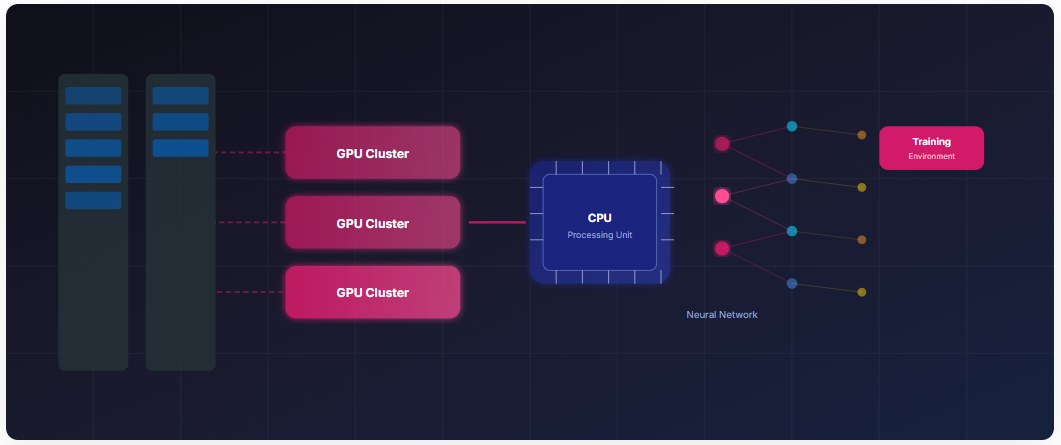
To understand the core issue, we must look at how modern AI is created. They are trained on massive server clusters equipped with high-performance GPUs.
Imagine a model as a musician who has spent their entire life playing on a specific type of concert grand piano. They are accustomed to the precise key response, the tuning, and how the sound resonates in a vast hall. All the mathematical computations forming the model's intelligence were calibrated within this specific environment. The model "knows" how to calculate based on the rules of this specific hardware architecture.
Model Training Environment (The "Gold Standard")
Modern AI models are trained on thousands of GPUs working in parallel within data centers.
2. The "Exchange Rate" Effect: When Mathematics Shifts
Now, imagine that same musician sitting down to play on a standard piano in your study.
From a mathematical perspective, every weight in a neural network is an immense number. When you run a model on different hardware (e.g., offloading part of the workload from a home GPU to a CPU), micro-adjustments occur in how the computer rounds numbers.
Here, a fitting analogy is currency exchange:
When the model was trained in the cloud, it operated in its "home currency" with a perfect exchange rate. When you initiate an offload (where part of the model works on the GPU and part on the CPU's RAM), a conversion occurs. It is like converting dollars to euros, and back again.
In every step, you lose "fractional value" due to rounding. In a standard calculator, this is negligible. But in AI, where billions of such calculations occur in a fraction of a second, this loss accumulates. Experts refer to this phenomenon as "Numerical Drift" (or Drift in Precision).
The result? The model no longer functions at its "100% potential." Its answers may become slightly "cloudier" or less logically precise than on the server where it was originally trained.
📈 Numerical Precision: Hardware Comparison
How much precision is retained depending on the execution environment?
This is why the same model can produce slightly different outputs depending on the hardware configuration you run it on.
| Factor | Cloud GPU | Home GPU | GPU + CPU |
|---|---|---|---|
| Precision | 100% | ≈99.5% | ≈92-97% |
| Speed | Fastest | Fast | Variable |
| Consistency | High | High | Lower |
| Quantization Impact | N/A | Moderate | Compounded |
3. The "Language Barrier" in MoE Models
Modern models often operate using a MoE (Mixture of Experts) architecture. Imagine that the model has different "brains" (experts) specialized for different tasks.
Ideally, if one expert processes data on the GPU (fast and precise) while another runs on the CPU (slower), a communication barrier arises:
- The GPU and the CPU speak different "languages" (different instruction sets).
- When data is passed from one expert to another, distortion occurs.
It is akin to the game of "broken telephone": one processor passes information to another, and in transit, certain semantic nuances are lost forever.
🤖 Mixture of Experts (MoE) Architecture
(GPU)
(CPU)
(Distorted?)
When the model's "experts" are spread across heterogeneous hardware, each expert processes its assigned task in its own hardware-native precision. But the results of those experts must be combined, and that combination happens across the hardware boundary — where the numerical precision can differ.
4. Is It Worth Worrying?
Although theoretically, your hardware does alter the model's "brain," the reality is not as dramatic for the average user.
Why this isn't usually a cause for alarm:
When Hardware Matters Less
- Quantization Matters More: When running models locally, we typically compress them (e.g., into the GGUF format). This compression blurs the precision far more significantly than the difference between a processor and a graphics card. The loss of quality from quantization is far greater than that caused by hardware incompatibility.
- AI Is Stochastic: Neural networks do not output a 100% identical answer for the same prompt if the temperature parameter is active. AI "hallucinates" or generates probabilistically. Therefore, minor distortions from hardware are simply drowned out by the model's inherent randomness.
When does it matter?
When to Be Cautious
If you use AI as a strict instrument—such as auditing legal documents, analyzing medical data, or writing complex code where 100% accuracy is paramount—then yes, using heterogeneous hardware (GPU + CPU) can yield inconsistent results across different runs.
- Legal document analysis & compliance
- Medical data processing
- Complex code generation where reproducibility is key
- Critical numerical computations
Conclusion
Simply put, a model's mathematical identity is tethered to the specific hardware that trained it.
To retrieve the "pure" brain of a model, it is best to run it on homogeneous hardware (either entirely on a GPU or entirely on a CPU). Mixing power sources (offloading) is a savior for speed and budget, but it is always a compromise.
You pay for convenience with a slight loss of mathematical "sterility" in the intelligence. For a casual chat, it is irrelevant. For precise sciences, it is critical.
In essence: hardware is not just the stage where AI performs. Hardware is part of the performance itself.