The Real Management Failure Is Not Lack of Frameworks. It Is Ideology Replacing Operational Judgment.

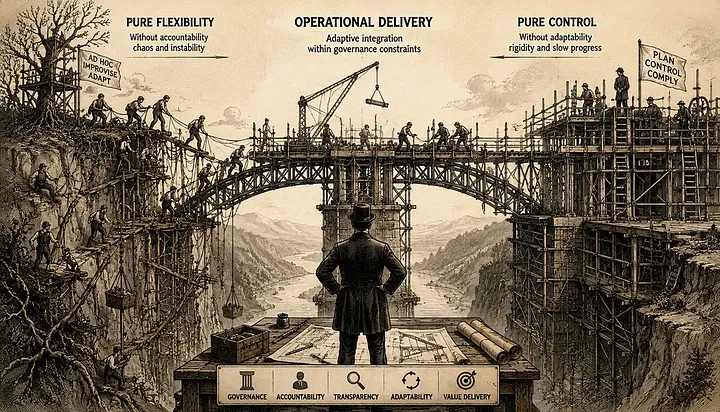
Over the last two decades, I have worked with organizations across very different environments: regulated finance, SaaS platforms, operationally constrained delivery, large engineering organizations, transformation programs, and Agile implementations at multiple scales.
And one pattern appears repeatedly.
Organizations stop managing operational reality and start managing management ideology.
Sometimes the ideology is control. Sometimes the ideology is empowerment. Sometimes the ideology is “process discipline.” Sometimes the ideology is “adaptability.”
The language changes. The failure pattern does not.
The result is usually the same: systems become less stable, less adaptive, or both.
Ironically, many modern management frameworks, including A Guide to the Project Management Body of Knowledge, have quietly moved toward a much more practical position than many online management debates would suggest.
Not toward rigid control. Not toward unrestricted self-organization. Toward constrained adaptability.
Or stated more simply:
Enable adaptation without breaking organizational accountability.
That sounds almost trivial. In practice, it is one of the hardest management balances to maintain.
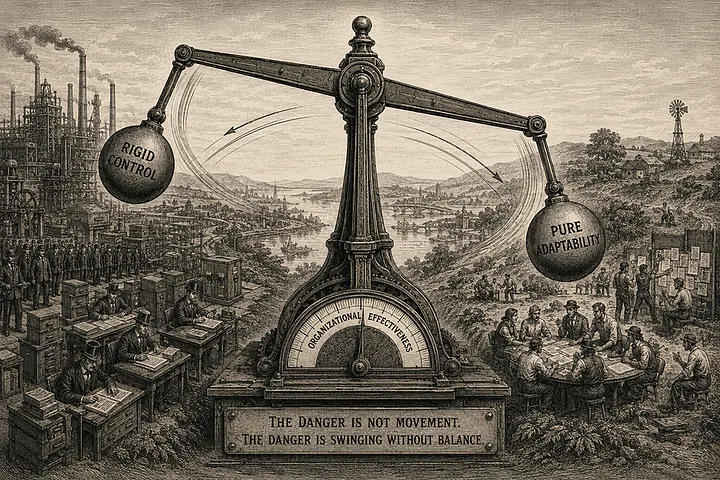
The Industry Spent Years Swinging Between Extremes
For decades, many organizations operated under heavily centralized management structures.
Decision-making was hierarchical. Escalation-heavy. Documentation-heavy. Control-oriented.
The problems with that model were real:
- slow adaptation,
- excessive bureaucracy,
- delayed feedback,
- low ownership,
- weak responsiveness to change.
Then came the large-scale Agile wave. And many organizations overcorrected. Instead of improving adaptability while preserving operational coherence, they treated structure itself as the enemy.
Governance became “anti-Agile.” Planning became “waterfall.” Documentation became “bureaucracy.” Accountability became “lack of trust.” Operational controls became “process theater.”
In some environments, management itself became viewed as a kind of organizational failure. The problem is that reality does not disappear because terminology changes. Dependencies still exist. Financial accountability still exists. Regulatory obligations still exist. Operational continuity still exists. Risk accumulation still exists. Organizations cannot self-organize their way out of physics.
At the same time, many traditionally managed organizations responded to uncertainty in the opposite direction.
They increased:
- centralization,
- managerial intervention,
- escalation layers,
- approval complexity,
- direct oversight.
This created a different kind of failure: organizations that were operationally rigid but strategically fragile.
The deeper issue in both cases was not process selection.
It was ideology replacing operational judgment.
Failure Mode 1: Management by Endless Facilitation
One of the most common patterns I observed during Agile transformations was the emergence of what I would call “management by facilitation.”
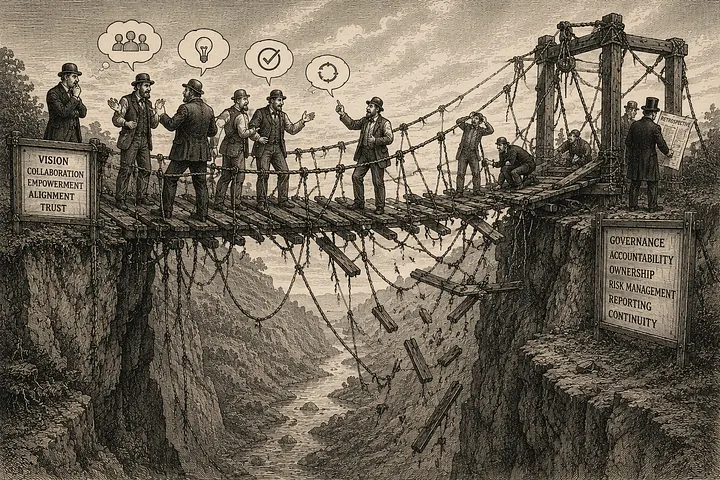
The PM, Scrum Master, or delivery leader became primarily a coordinator of conversations.
Typical symptoms:
- excessive facilitation,
- endless collaboration,
- over-trusting self-organization,
- underestimating governance/accountability,
- assuming alignment naturally emerges,
- focusing on mindset before operational continuity.
The hidden assumption usually looked something like this:
“If people understand each other better, the system will work.”
There is truth inside this idea.
Communication matters. Shared understanding matters. Psychological safety matters. Team engagement matters.
But organizations are not held together by communication alone. They are held together by operational structures capable of surviving stress. And this is where purely ideological interpretations of Agile often become dangerous.
Because systems eventually encounter:
- cross-team dependencies,
- budget constraints,
- regulatory requirements,
- contractual obligations,
- production incidents,
- security failures,
- scaling challenges,
- conflicting stakeholder incentives.
At that point, somebody must still:
- define ownership,
- preserve continuity,
- manage escalation,
- maintain reporting obligations,
- make bounded decisions,
- integrate constraints into delivery.
This is one reason why PMI-oriented guidance increasingly emphasizes accountability alongside adaptability.
The concern is not theoretical. The concern is operational.
Typical organizational consequences of excessive facilitation include:
- accountability gaps,
- unclear ownership,
- unmanaged risk,
- broken reporting/compliance,
- stakeholder instability,
- lack of decisive action.
I have seen organizations where “empowered teams” technically owned delivery, but nobody could explain:
- who owned cross-system reliability,
- who accepted operational risk,
- who managed economic trade-offs,
- who coordinated dependencies,
- who had authority during incidents.
Eventually the organization compensates for this ambiguity informally.
Usually through hidden hierarchy, political escalation, or emergency intervention.
The structure returns anyway. Only now it is less visible and less accountable.
The practical correction is not abandoning collaboration. It is integrating collaboration into operational governance.
Correction:
- preserve continuity,
- maintain reporting/control obligations,
- define ownership,
- produce a practical next step,
- operate within current structures while improving them.
A good PM is not only a facilitator. They are an integrator of organizational constraints.
Failure Mode 2: The Hero Manager
The opposite failure mode is equally destructive. Especially in organizations under pressure. Here, the PM or manager becomes the operational center of gravity for everything.
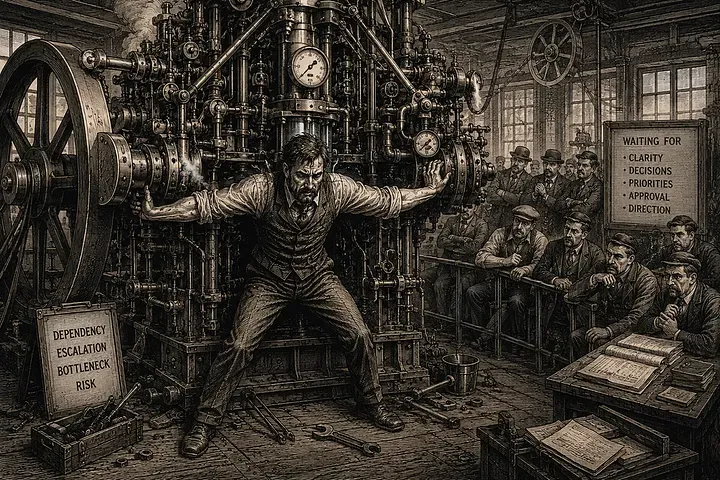
Typical symptoms:
- command-and-control reflex,
- bypassing team ownership,
- solving instead of enabling,
- unilateral decisions,
- escalating too early,
- over-centralizing authority.
The hidden assumption usually becomes:
“The fastest way to solve the problem is direct intervention.”
And to be fair: sometimes it is. Experienced leaders often can temporarily solve problems faster through direct control. But organizations optimized around heroic intervention become structurally fragile over time.
The system gradually loses:
- distributed ownership,
- local decision capability,
- adaptability,
- resilience,
- initiative,
- learning capacity.
The PM becomes a throughput constraint.
Teams stop solving problems proactively because authority has already centralized itself around the manager. The result is not stronger governance. It is dependency.
Typical consequences include:
- weak stakeholder buy-in,
- low team engagement,
- unsustainable leadership,
- reduced adaptability,
- damaged collaboration,
- dependency on the PM.
This pattern becomes particularly dangerous during growth phases. The “hero manager” model scales poorly because human escalation bandwidth does not scale linearly with organizational complexity.
Sooner or later: everything waits for approval, everything waits for coordination, everything waits for prioritization, everything waits for intervention.
The organization becomes slower precisely because leadership became too centralized.
The practical correction is not abandoning leadership authority.
It is using authority selectively while building distributed operational capability.
Correction:
- involve stakeholders,
- empower the team,
- facilitate shared understanding,
- use servant leadership where appropriate,
- prefer influence over authority.
A PM is not supposed to become the bottleneck hero. The organization itself must become more capable over time.
Mature Organizations Learn to Operate Between Extremes
The most effective delivery organizations I have seen were rarely ideological.
They understood something simpler:
Every organization operates under constraints. Some are financial. Some are operational. Some are technical. Some are regulatory. Some are political. Some are human.
Management maturity is not eliminating constraints through philosophy.
It is adapting within constraints without losing operational coherence.
That is a much more difficult skill than either:
- pure decentralization,
- or pure control.
Because it requires continuous balancing. Not slogans. Not rituals. Not ideological purity. Balancing.
That is why the practical management stance increasingly looks like this:
- respect organizational governance,
- preserve delivery continuity,
- engage stakeholders collaboratively,
- empower teams appropriately,
- adapt processes pragmatically,
- escalate only when necessary,
- improve systems incrementally, not ideologically.
Or more compactly:
Neither passive facilitator nor command-and-control hero. The PM is an adaptive integrator.
Why This Matters More in the AI Era
AI-assisted work is already amplifying both organizational failure modes.
Weak governance scales chaos faster. Poor assumptions spread further. Locally optimized decisions become cheaper to produce.
At the same time, over-centralized organizations become even larger bottlenecks because decision load increases faster than human coordination capacity.
The answer is not “more AI.” The answer is not “more process.” It is stronger operational integration.
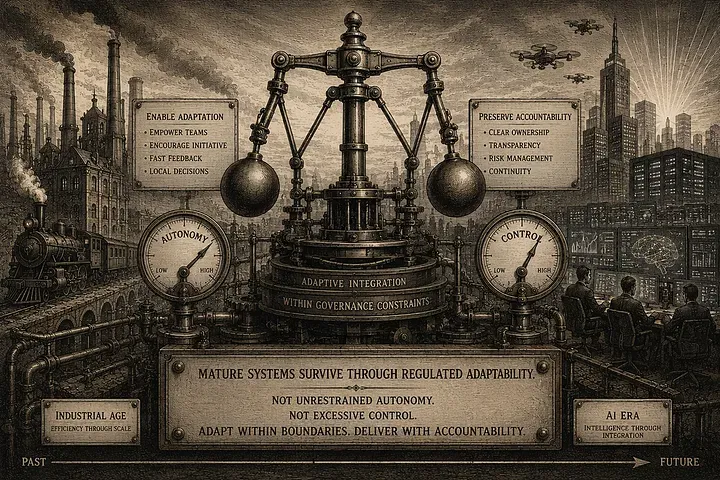
Organizations increasingly need systems capable of:
- adaptive execution,
- bounded autonomy,
- visible accountability,
- fast feedback,
- survivable governance.
In many ways, this is why modern PM guidance has become more pragmatic over time. Not because organizations became less adaptive. Because they discovered adaptation without accountability eventually becomes operational instability.
And accountability without adaptability eventually becomes strategic paralysis. The organizations that survive long term are rarely the most ideological. They are the ones capable of adapting while remaining operationally coherent.
And this balance is far closer to real-world delivery than many management debates on the internet.